

Surgical Implant Guides

Guided surgery is a system, not a part — the guide, the sleeve, the kit, and the plan have to agree. We build the guide around the protocol a dentist actually runs.

The most common reason a surgical guide fails in the operatory is not a bad design. It is a guide built around a drill kit the surgeon does not have — a sleeve, an offset, and a sequence that belong to somebody else's system.

Jahn De Khudikine, Founder · Universal Dental Lab
Jahn De Khudikine Founder · Universal Dental Lab

Why send it here

A guide is only as good as the protocol behind it. We settle that with you first.

A practice's schedule lives or dies by the lab — I've watched one late case push back a whole day of chair time.

So I still know the cases moving through this lab, and I answer for how each one is made. Send a case here and it doesn't drop into a queue — it lands with me and one technician who carries it start to finish.

Start a case
Protocol first
The kit and the sequence set the guide, not the anatomy It is an input to the design, not a detail found halfway through
Built for your kit
Sleeve and offset matched to the system you own The sequence in the operatory matches the guide on the model
Your technician
One planner holds your case Reach them directly — no call-center queue
Free scanner
3Shape TRIOS 6 for partners Go fully digital at no cost
Universal Dental Lab Guided case sheet

What to send with the case

  • CBCT scan (DICOM)
  • Intraoral scan (STL)
  • Implant system and platform
  • Guided protocol: pilot / partial / full
  • The guided kit you own
  • Planned prosthesis or wax-up, if any

The protocol and the guided kit are the details most often left out — and the ones that decide the sleeve, the offset, and the drill sequence.

How We Work With You

A Guide Built for the Kit You Own

So we start with the protocol, not the anatomy. Pilot, partially guided, or fully guided — and which guided kit you own — determines the sleeve diameter, the drill offset, and the depth stops before a single implant is positioned. That makes it an input to the design, not a detail we discover halfway through.

The build
A guide built for the specific implant system and the guided kit you actually own — sleeve diameter, drill offset, and depth stops set to your sequence, not somebody else's system.
What we weigh
The accuracy chain — the CBCT, the registration of the scan to it, how the guide seats, the sleeve tolerance, and the drill. Guided placement narrows deviation; we plan margins to the inferior alveolar canal, the sinus, and adjacent roots for that accumulated tolerance.
You approve
You see the sleeve positions, the support, and the drill sequence the guide assumes before anything prints. Changes here cost a conversation; changes after printing cost a guide.
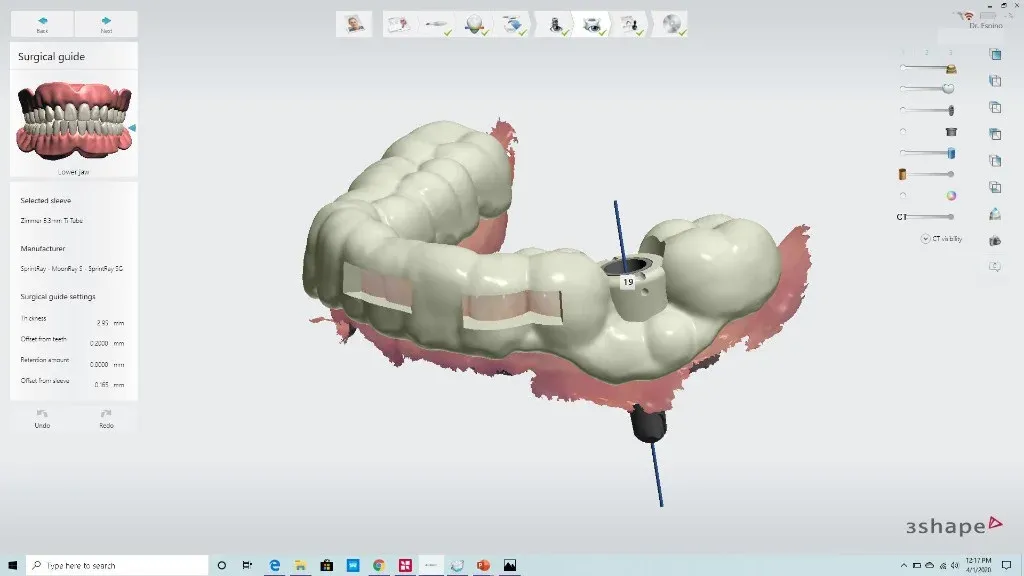
Guided planning software showing implant positions and the drill sequence overlaid on a CBCT

Accuracy

Guided Surgery Narrows Deviation — It Does Not Erase It

Accuracy is a chain: the CBCT, the registration of the scan to it, how the guide seats, the tolerance in the sleeve, and the drill itself. Every link contributes. Guided placement is dramatically more predictable than freehand, but the honest way to plan it is to leave margin to the inferior alveolar canal, the sinus, and adjacent roots for that accumulated tolerance — not to plan to the last fraction of a millimeter and hope.

  • The tolerance chain: CBCT, registration, guide seat, sleeve, and drill — every link adds deviation, so margins are planned around the stack, not the ideal.

  • Restoratively driven positions: The positions the guide enforces come from the restorative plan, not from where the bone was easiest.
Learn more
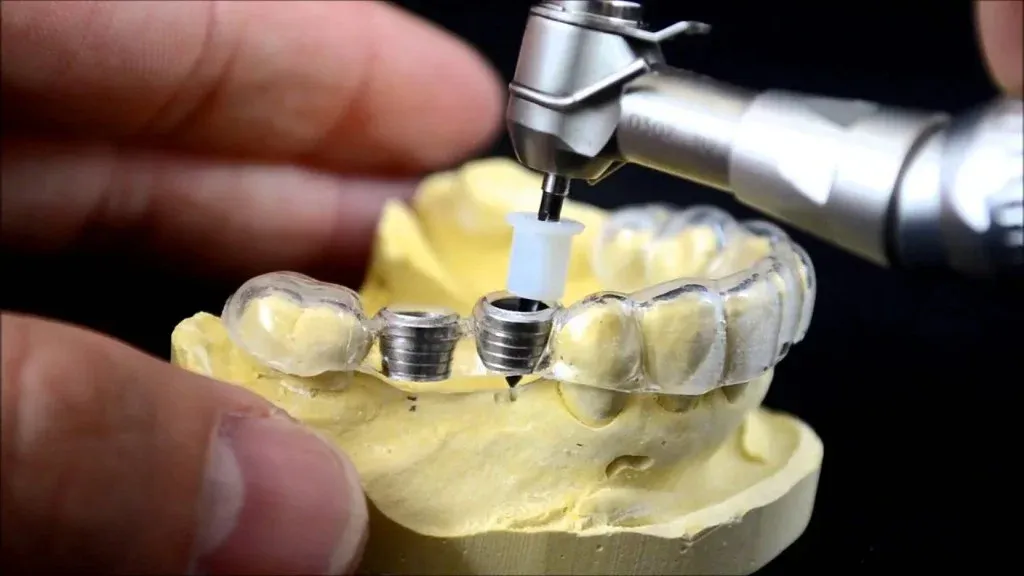
Printed surgical guide with seated metal sleeves being inspected on the model

Materials & Fabrication

Sleeved to the System, Shipped With the Protocol

The sleeve is the component your entire tolerance budget passes through. We seat metal sleeves matched to the system and guided kit in a biocompatible printed body, and check the seated assembly against the plan — because a sleeve sitting a fraction off carries straight into the osteotomy.

Each guide leaves the lab with the drill protocol it was designed around, so nobody has to reverse-engineer the sequence in the operatory. Where a different protocol would make the case safer, we say so before production rather than after.

  • Sleeved to your kit: Metal sleeves matched to the implant system and guided kit, checked as a seated assembly against the plan.

  • Shipped with the protocol: The drill protocol the guide was designed around travels with it — no reverse-engineering the sequence chairside.

Learn more

Full-arch cases run as a stack

On an edentulous arch the placement guide rarely works alone — it sequences with a bone reduction guide and fixation, and the guides are designed to share references so what follows the reduction still seats where the plan put it. The positions themselves come from restoratively driven planning, and the guide is how they reach the mouth.

The Process

How a Guided Case Is Built

Protocol first, records second, approval before anything prints.

  1. Tell us the protocol before the plan

    Practice

    Pilot, partially guided, or fully guided — and which guided kit you own. The protocol decides the sleeve, the offset, and the drill sequence, so it is an input to the plan, not an afterthought.

  2. Records: CBCT plus intraoral scan

    Practice

    A CBCT in DICOM and an intraoral scan in STL, taken close enough together that the anatomy still agrees, plus the implant system and platform you intend to place.

  3. We build the guide to your kit

    Lab

    Sleeve diameter, drill offset, and depth stops are set for the specific system and guided kit. A guide built for a kit you do not own is a guide you cannot use.

  4. You approve before it prints

    Practice

    You see the sleeve positions, the support, and the drill sequence the guide assumes. Changes here cost a conversation; changes after printing cost a guide.

  5. Printed, sleeved, and shipped with the protocol

    Lab

    We print in biocompatible resin, seat the metal sleeves, inspect against the plan, and ship the guide with the drill protocol it was designed around.

What guided surgery actually gives you

  • The guide is only one link in the chain

    Accuracy accumulates across the CBCT, the scan registration, the guide fit, the sleeve tolerance, and the drill. Guided surgery narrows deviation — it does not eliminate it, and we plan margins accordingly.

  • Built for the kit in your drawer

    Sleeve and offset are matched to the implant system and guided kit you actually own, so the sequence in the operatory matches the guide on the model.

  • Guided serves the restoration

    A guided position that ignores the prosthesis is a precise mistake. The positions the guide enforces come from the restorative plan, not from where the bone was easiest.

Start a case

Send one case. Keep the scanner.

Open a partner account and your first case moves with a shade record and our remake guarantee — if a unit does not seat, we redo it at no charge.

  • Free 3Shape TRIOS 6 scanner for active partners
  • Under-2% remake rate — remakes at no charge
  • One named technician you reach directly — no call center

Prefer to talk? +1 747-268-0808

No call center — you hear back from the lab, not a bot.

Guided Surgery FAQ

Surgical Implant Guides — Questions Dentists Ask

Send a CBCT in DICOM and an intraoral scan in STL, the implant system and platform, and — the detail most often left out — the guided protocol and the guided kit you own. Pilot, partially guided, and fully guided produce different guides with different sleeves and offsets, so we need to know before designing rather than assume. If a planned prosthesis or wax-up exists, include it, because the guide should enforce positions that serve it.

Scatter from metal restorations and motion artifact. We register intraoral scans from iTero, 3Shape, or Medit to the CBCT; a clean CBCT and a complete arch scan taken close together make the guide far more reliable than a noisy volume patched after the fact.

How to send a file

Guided placement narrows deviation substantially compared with freehand, but it does not eliminate it — accuracy accumulates across the CBCT, the scan registration, how the guide seats, the sleeve tolerance, and the drill itself. The practical implication is that margins to the inferior alveolar canal, the sinus, and adjacent roots are planned with that tolerance stack in mind, not to the last fraction of a millimeter. Anyone promising you absolute accuracy is selling something.

Most guide problems trace to one of two things: a guide built for the wrong kit, or a support surface the scan never captured properly. We confirm the guided kit and implant system before designing, and verify the finished guide against the plan before it ships — both failures are caught before printing when records and protocol are confirmed up front.

Ideally before the CBCT is taken. A guide enforces whatever plan it was built from, so the value is in getting that plan right — restoratively driven, with margins that respect the anatomy. For full-arch cases, the guide is usually one part of a stack that includes reduction.

Guided implant planning

Partner Offer

A Free Intraoral Scanner for Partner Practices

Partner with Universal Dental Lab and we place a 3Shape TRIOS 6 Wireless in your operatory — free for the length of our partnership. Scan the prep, send it in seconds, and skip impressions entirely.